A payment follow-up is a short message asking a client to pay an invoice that is due or overdue. Send the first one 3 to 5 days before the due date, then follow up on day 1 to 3, day 7, day 14 and day 21 after it, each message a step firmer than the last. Every follow-up should name the invoice number, the amount, the original due date and how to pay, and ask for one thing: payment, or a date.
That is the whole method. The rest of this page gives you the email for each stage, a checklist for what goes in every message, and what to do when the schedule runs out.
In a hurry? The free payment follow-up email generator writes the right email for your stage with your client's name, invoice number and amount already filled in. No signup.
Try it on yours
Edit the sentence and press Continue. Free for 3 reminders, no card.
The payment reminder timeline at a glance
| Stage | When to send | Tone | What it asks for |
|---|---|---|---|
| Pre-due note | 3 to 5 days before due | Warm, matter-of-fact | Nothing yet, just a heads-up |
| Polite nudge | Day 1 to 3 overdue | Friendly | Payment, or tell me if it's lost |
| Direct follow-up | Day 7 overdue | Professional, clear | A payment date |
| Firm reminder | Day 14 overdue | Firm, businesslike | A reply today |
| Final notice | Day 21 overdue | Urgent, specific | Payment by a named date, or else |
About a week between overdue messages is the rhythm most people settle on. Close enough that the invoice stays on the client's list, far enough apart that it doesn't read as harassment.
What to include in every payment follow-up email
Whatever the stage, the message needs the same few things. Skip one and you give the client a reason to reply with a question instead of a payment.
- Invoice number in the subject line, so it can be found and forwarded to whoever pays bills.
- The amount and the original due date, in the first sentence.
- Days overdue, once it is overdue. A number is harder to argue with than "a little late".
- How to pay: a payment link, bank details or the invoice attached again.
- One direct question: "Could you confirm the date this will be paid?"
- Nothing else. No project updates, no apology, no "just checking in".
Reply in the same email thread as the original invoice where you can. The client sees the history, and nobody has to search for the attachment.
The five payment follow-up emails
1. Before the due date: the pre-due note
Send this 3 to 5 days before the invoice is due. It catches invoices that went to the wrong person or landed in spam while there is still time to fix it, and it doesn't accuse anyone of anything because nothing is late yet.
Subject: Invoice [#number] due [date]
Hi [Name],
Quick note that invoice [#number] for [amount] is due on [date]. The payment link is here: [link]. Let me know if you need anything from me before then.
[Your name]
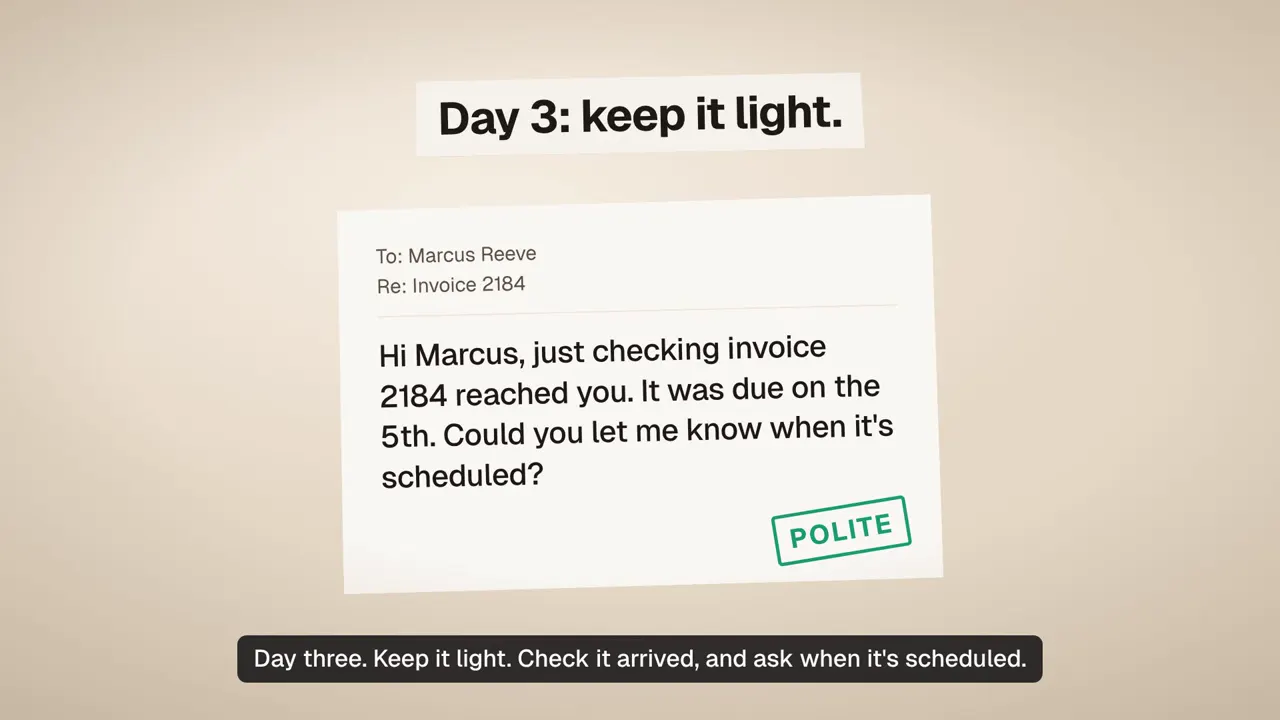
2. Day 1 to 3 overdue: the polite nudge
The due date has passed. Don't wait a week to say something. Most invoices at this point are late because of an oversight, so write it like one.
Subject: Invoice [#number], payment reminder
Hi [Name],
Invoice [#number] for [amount] was due on [date]. Flagging it in case it slipped through. I've attached it again, and I'm happy to resend it to someone else if that helps.
[Your name]
No apology. No "sorry to bother you." A clear, friendly flag.
3. Day 7 overdue: the direct follow-up
A week late is no longer an oversight you can assume. The tone stays polite, but now you name the situation and ask for a date.
Subject: Invoice [#number], 7 days overdue
Hi [Name],
Invoice [#number] for [amount] is now 7 days overdue. Could you confirm when payment will be processed? If something is holding it up on your side, let me know and we can sort it out.
[Your name]
If you want help with the wording of this message, which is the one most people get wrong, how to write a firm second follow-up goes line by line.
4. Day 14 overdue: the firm reminder
Two weeks overdue is a real problem and the message should say so. Businesslike, not angry. A specific ask with a specific timeframe.
Subject: Invoice [#number], 14 days overdue, action needed
Hi [Name],
Invoice [#number] for [amount] is now 14 days overdue. Please reply today with either a payment confirmation or the date you will process it. As a reminder, our agreement includes a late fee of [fee] on invoices more than [X] days overdue.
[Your name]
Leave the late fee line out if your contract doesn't have one.
5. Day 21 overdue: the final notice
This is the last message before you act. State the consequence, give a date, and only name a consequence you will actually follow through on.
Subject: Invoice [#number], 21 days overdue, final notice
Hi [Name],
Invoice [#number] for [amount] is now 21 days overdue and I haven't had a reply to my previous messages. If I don't receive payment or a confirmed payment date by [specific date], I'll [pause work on the project / apply the late fee in our contract / refer this to collections].
[Your name]
For more wording at the firm and urgent end, including what to send when the client replies asking for more time, see the three-step escalation emails for overdue invoices.
Want one of these filled in with your client's name, invoice number and amount? The free payment follow-up email generator writes the polite, firm or final version for you, no signup needed.
Payment follow-ups and collections: when to stop sending reminders
After the day 21 notice, more reminders rarely change anything. You have five messages on record, which is the paper trail you need for whatever comes next. The usual options, roughly in order:
- Call the client. Then send a short email confirming what was agreed on the call.
- Apply the late fee your contract allows, on a new invoice or a revised one.
- Pause further work until the balance is cleared, and say so in writing.
- Hand it to collections or small claims. For larger amounts, a collections agency or a small claims filing is the next step. Rules and limits vary by country and state, so check the local process before you start.
If a client replies at any stage, the schedule stops there. You are now in a conversation, and the next message should answer what they said rather than move to the next template.
Common payment follow-up mistakes
- Waiting too long to send the first one. A first message at day 10 has already lost a week and a half. Start at day 1 to 3.
- Skipping the pre-due note. It is the only message that can stop an invoice going overdue at all.
- Spacing the reminders too far apart. Day 3 to day 30 tells the client nobody is watching. Keep it close to weekly.
- Using the same tone every time. If the fourth message reads like the first, it gets ignored like the first. Each one should be a step firmer.
- Stopping before the final notice. Two soft reminders and then silence is the most common pattern, and the one that leaves invoices unpaid longest.
Most of these are not writing problems, they are memory problems. The 7 signs your invoice follow-up process is costing you money covers the others.
How to schedule payment follow-ups without doing it by hand
The schedule above is easy to agree with and hard to keep. Five dates per invoice, across several clients, while also doing the work you are being paid for.
The low-tech version: when you send an invoice, put the five dates in your calendar with the invoice number in each entry. When a client pays or replies, delete the rest.
The automated version: tools can send the messages for you. Before you pick one, check two things. Does it stop when the client replies, so nobody gets a "still waiting" email after they have paid? And does it send from your own address, so the reminder arrives in the same thread as the invoice instead of from a no-reply address?
autoremind.ai is built around those two points. You describe the invoice in one sentence, for example "invoice #1042 for $2,400 to Sam at Acme, due on the 15th", and it writes and sends the follow-ups from your own Gmail, in the original thread, getting firmer each time (professional, then firm, then urgent). It stops when the client replies, and it notices the reply without reading your inbox: here is how that works.
One reminder sends at most four messages, so pick four of the five stages above. Most people send the pre-due note with the invoice themselves and let the tool handle the four overdue messages. The free plan covers 3 live reminders with no card; Starter is $4 a month for 10.
If you are a freelancer setting this up for the first time, the automated invoice reminders guide for freelancers walks through it step by step.
FAQs
What is a payment follow-up? A payment follow-up is a message asking a client to pay an invoice that is due or overdue. A good one names the invoice number, the amount, the original due date and how to pay, and asks for one specific thing: payment, or a date when payment will be made.
When should I follow up on a payment? Send a short note 3 to 5 days before the due date, then follow up 1 to 3 days after it passes, again at day 7, day 14 and day 21. Keep roughly a week between messages and make each one a step firmer than the last.
How many reminders should I send before collections? Five is a sensible number: the pre-due note and four overdue follow-ups ending around day 21. After that, either apply the late fee in your contract, pause further work, call the client, or refer the invoice to a collections agency or small claims, depending on the amount.
What should I write in a payment follow-up email? Put the invoice number in the subject line. In the body, give the amount, the original due date and how many days overdue it is, attach or link the invoice, and ask a direct question such as "Could you confirm the date this will be paid?" Leave out apologies and phrases like "just checking in."
How do I schedule payment follow-ups so I don't forget them? Put the dates on a calendar the day you send the invoice, or use a tool that sends them for you. With autoremind.ai you describe the invoice in one sentence and it sends up to four follow-ups from your own Gmail, in the original thread, each firmer than the last, and stops when the client replies.
Can I tie payment follow-ups to contract milestones rather than a due date? Yes. Treat the milestone payment date as day zero. Send the pre-due note a few days before the milestone payment is due, then run the day 3, 7, 14 and 21 stages from that date.
Should I call instead of emailing when an invoice is overdue? A call can work at day 14 or day 21, especially for larger invoices or long-term clients. Always follow the call with a short written summary of what was agreed, because a call on its own leaves no record.
What if the client says they'll pay "soon" but never does? Ask for a specific date. "Soon" is not a payment commitment. Reply with: "Thanks, can you confirm the exact date payment will be processed?" Then keep the schedule running until you have the date or the money.
When should I mention late fees in a reminder? Mention your late fee policy in the day 14 message if it is in your contract, and name the specific fee in the day 21 message. It should already be in your original invoice terms, so it is a reminder, not a surprise.
See also: How to follow up on an unpaid invoice politely · Recovering invoices that are already weeks overdue · Slack vs email for payment reminders · The freelancer's guide to getting paid on time